

Manhole Covers Market to Surpass $10.32 Billion by 2035 as Smart Cities and 5G Reshape Underground Infrastructure
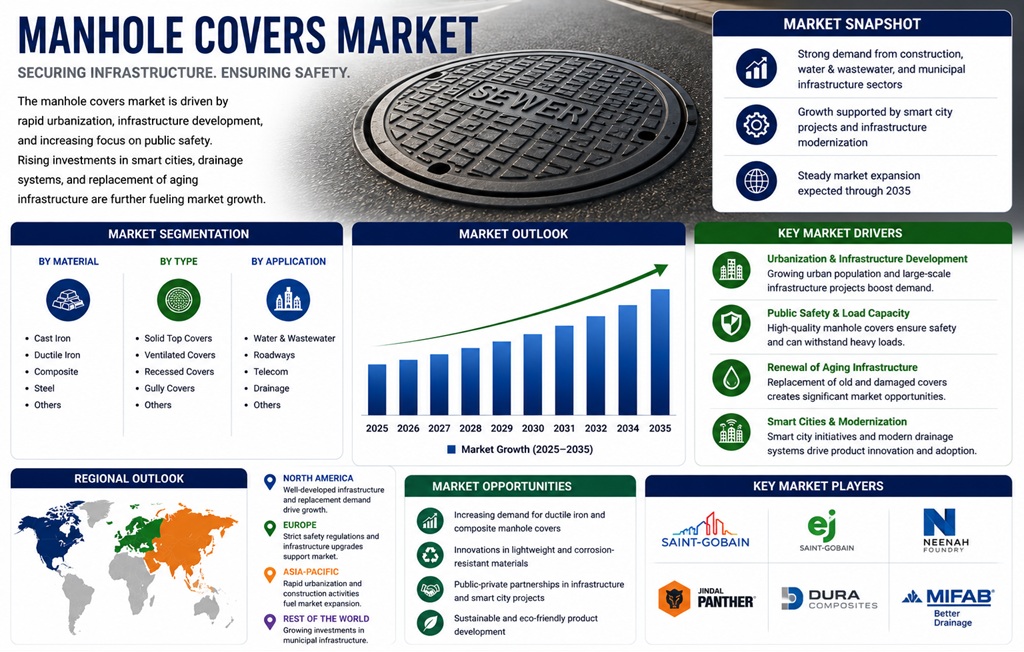
Manhole Covers Market (2026 - 2035)
Europe commands the largest share of the Manhole Covers Market at approximately 37.6% of 2025 revenue
OR, UNITED STATES, July 16, 2026 /EINPresswire.com/ -- According to a comprehensive report by Market Research Future (MRFR), the global manhole covers market reached an estimated USD 6.12 billion in 2025 and is projected to grow from USD 6.45 billion in 2026 to USD 10.32 billion by 2035, registering a compound annual growth rate of 5.37%. This growth is anchored in accelerating urbanization—the UN projects 68% of the global population will live in cities by 2050—and the corresponding surge in underground utility buildouts. Governments across the EU, China, and North America have collectively pledged over USD 420 billion toward water, wastewater, and broadband infrastructure between 2024 and 2032, directly expanding procurement volumes for these essential assets.The Material Revolution: From Iron to Intelligence
The most profound shift reshaping the manhole covers market is the migration from traditional metal to advanced composite materials. For over a century, cast iron and ductile iron dominated municipal procurement, valued for their load-bearing capacity and durability. But a material technology shift is redefining the competitive landscape. Traditional grey iron and ductile iron covers are losing ground to fiber-reinforced polymer (FRP) composites and polymer-concrete alternatives that offer superior corrosion resistance, lower installation weight, and built-in anti-theft characteristics.
Cast iron captured approximately 42.7% of market revenue in 2025, reflecting its continued specification dominance in legacy road and highway projects across Europe and North America. Its dominance, however, is eroding as composite alternatives demonstrate competitive 50-year lifecycle costs when factoring in theft resistance, corrosion immunity, and lower installation labor. The market is witnessing a gradual but irreversible shift toward composite materials in telecom, pedestrian, and flood-prone applications where metal covers present functional disadvantages.
Ductile iron remains the second-largest material segment, valued at approximately USD 1.41 billion in 2025. It occupies the premium tier of the market, favored for heavy-traffic urban intersections and airport taxiways where impact resistance is paramount. Manufacturers like EJ Group and Saint-Gobain PAM continue to invest in ductile iron foundry capacity even as composite adoption accelerates, recognizing that critical load-bearing applications will sustain demand through 2035 and beyond.
Download Report Sample Copy: https://www.marketresearchfuture.com/sample_request/1372
Composite materials are forecast to register the fastest material-type CAGR of 6.29% through 2035, propelled by telecom 5G lid requirements and anti-theft mandates. These materials are particularly compelling in applications where metal's properties become liabilities rather than assets. Telecom operators rolling out 5G small cells require RF-transparent lids that metal simply cannot provide. A standard cast-iron cover attenuates millimeter-wave signals by 20–30 dB, effectively creating dead zones for 5G coverage directly above utility access points. RF-transparent composite lids use glass-fiber reinforcement without carbon or metallic fillers, allowing signals to pass through unimpeded.
The 5G Imperative: Underground Infrastructure Goes Digital
The rollout of 5G telecommunications infrastructure is creating a new demand vertical for the manhole covers market that barely existed a decade ago. A dense network of small-cell nodes—many of which use below-grade access points for fiber-optic and power distribution—is necessary for 5G deployment. The European Commission's "Digital Decade" initiative targets simplifying the deployment of small-area wireless access points (SAWAPs) across member states. The industry is increasingly using RF-transparent composite lids to avoid signal attenuation, particularly in high-density urban regions where millimeter-wave performance is crucial.
The telecommunication and data application segment is projected to expand at a 6.49% CAGR through 2035, the fastest among all application segments. This growth reflects the simultaneous rollout of 5G and fiber-to-the-premises, which demands tens of thousands of new below-grade access points annually across Asia, Europe, and North America. Each small-cell node requires an access point for fiber and power, and municipalities are increasingly specifying non-metallic covers as standard practice for telecom infrastructure.
Smart Cities: From Passive Cover to Active Sensor Platform
Perhaps the most futuristic transformation in the manhole covers market is the integration of IoT sensors directly into cover assemblies. Municipalities are progressively integrating environmental and structural health sensors to monitor vital data, including real-time flood levels, toxic gas accumulation such as hydrogen sulfide, and unlawful access. Agencies like Singapore's PUB are increasingly including digital-ready infrastructure criteria in new utility contracts.
Cities that have piloted these systems report 20–35% reductions in emergency maintenance callouts. By switching from reactive schedules to data-driven, predictive models, these installations improve infrastructure resilience in an increasingly urbanized environment. The addressable opportunity for smart covers alone could reach USD 1.2 billion by 2032 as urban digital-twin platforms demand real-time underground asset data.
By 2030, a predicted 15% of new cover installations in advanced metropolitan economies are likely to incorporate embedded sensors. These sensors provide continuous data streams on flow, temperature, and structural integrity, enabling utilities to migrate from reactive replacement cycles to predictive, condition-based maintenance models. The confluence of IoT-equipped covers with municipal digital-twin platforms is transforming the market from commodity hardware to data-integrated asset management.
Anti-Theft: The Public Safety Imperative
Metal theft of manhole covers poses public safety hazards and costs municipalities millions annually. India's Bureau of Indian Standards updated IS 1726 in 2024 to mandate locking mechanisms and composite alternatives in high-theft zones, a specification change affecting an estimated 12 million covers across municipal networks. South Africa's Johannesburg Water reported replacing over 40,000 stolen covers per year at a cost exceeding ZAR 180 million, accelerating the shift to theft-resistant composite designs.
Composite covers carry virtually zero scrap value, eliminating the economic incentive for theft that drives the replacement cycle in metal-dependent markets. In theft-prone regions, the lifecycle cost advantage of composites becomes overwhelming: a single stolen cast-iron cover may cost USD 150–300 to replace, while a composite equivalent, though priced at a 20–30% premium upfront, eliminates recurring theft losses.
Purchase Now: https://www.marketresearchfuture.com/checkout?currency=one_user-USD&report_id=1372
Urban Water and Sewer Expansion: The Volume Bedrock
Strong below-ground utility networks are becoming increasingly necessary due to rapid urbanization. The Jal Jeevan Mission (JJM) remains a pillar of water infrastructure strategy in India, with a government allocation of roughly INR 67,670 crore for the 2026–2027 fiscal year. Standardized, long-lasting access points are required for continuous maintenance with every new connection. In a similar vein, China's approach to urban water infrastructure has evolved; long-term operational maintenance and real-world performance monitoring of drainage and infiltration systems have taken precedence over the initial construction-heavy phase of the "Sponge City" plan. These utility-scale projects guarantee a consistent, high-volume procurement pipeline.
Water and wastewater represent the second-largest application, valued at approximately USD 1.53 billion in 2025, with developing economies investing heavily in first-time sewer network construction. Road infrastructure drives the greatest application-level demand, accounting for roughly 31.7% of the market in 2025, where covers must meet stringent load classifications for vehicle traffic.
Regional Dynamics: Europe Leads, Asia-Pacific Surges
Europe commands the largest share of the manhole covers market at approximately 37.6% of 2025 revenue, driven by strict EN 124-compliant procurement standards and dense underground utility networks. Germany anchors regional demand at 21% of share through autobahn resurfacing and DIN/EN standards. The UK's AMP8 regulatory period (2025–2030) commits water companies to GBP 96 billion in network investment, creating a sustained procurement pipeline. France's Grand Paris Express metro expansion and Italy's PNRR infrastructure modernization sustain demand across the continent.
Asia-Pacific is the fastest-growing region, posting an anticipated CAGR of 6.13% through 2035, led by massive metro rail expansions in India and China's "sponge city" stormwater programs. China alone contributes 38% of regional share, with sponge-city programs and metro buildouts driving volume. India's 6.82% CAGR is the fastest country-level growth rate, powered by the Jal Jeevan Mission and Smart Cities Mission. India alone installed an estimated 3.8 million new covers between 2022 and 2025 under Smart Cities Mission phases.
North America holds roughly 22% of the global market, where aging water systems and the Bipartisan Infrastructure Law's USD 55 billion water allocation are sustaining replacement-cycle demand. The United States dominates with 71% of regional share, propelled by EPA Clean Water State Revolving Fund disbursements. Charlotte Pipe's 2026 acquisition of Neenah Foundry signals consolidation pressure as buyers seek national supply assurance and economies of scale.
South America is valued at USD 0.43 billion in 2025, with Brazil dominating at 58% of regional share through PLANSAB sanitation targets. Brazil's Marco Legal do Saneamento (2020) mandates universal sanitation coverage by 2033, requiring massive expansion of sewer networks and corresponding cover procurement.
The Middle East & Africa is advancing at a 5.67% CAGR, driven by contrasting dynamics: Gulf states deploying premium composite covers for smart-city districts, while Sub-Saharan African municipalities grapple with theft-replacement volumes. Saudi Arabia's NEOM project alone specifies over 85,000 composite IoT-enabled covers for its linear city infrastructure.
Read More: https://www.marketresearchfuture.com/reports/manhole-covers-market-1372
Competitive Landscape
The manhole covers market exhibits moderate concentration, with the top five players accounting for an estimated 28–35% of global revenue. The Herfindahl-Hirschman Index is low relative to concentrated industrial markets, reflecting a fragmented supply base of regional foundries alongside a handful of multinational manufacturers pursuing consolidation strategies.
EJ Group leads with an estimated 7–10% revenue share, distinguished by global distribution and a multi-material portfolio spanning ductile iron, grey iron, and composite covers. Saint-Gobain PAM captures 6–9% as the European market leader with a sustainability focus, including closed-loop recycling programs. Neenah Foundry (Charlotte Pipe) holds 4–7% following its 2026 acquisition, creating the largest North American cover manufacturer with estimated combined revenue exceeding USD 400 million. Fibrelite specializes in GRP composite covers and telecom-grade RF-transparent lids at 3–5%, while Crescent Foundry leverages India-based, price-competitive supply at 3–5%.
Recent strategic moves signal industry consolidation. Charlotte Pipe completed its acquisition of Neenah Foundry in January 2026, consolidating two major U.S. ductile-iron producers. In November 2025, Charlotte Pipe and Foundry Company and Neenah Foundry acquired Bingham & Taylor, a family-run business specializing in subterranean infrastructure access solutions, expanding their product line and clientele. Saint-Gobain PAM opened a closed-loop recycling line at its Pont-à-Mousson plant in June 2025, enabling 92% material recovery from decommissioned iron covers.
Related Report
Ductile Iron Pipes Market https://www.marketresearchfuture.com/reports/ductile-iron-pipes-market-7599
Iron Ore Market https://www.marketresearchfuture.com/reports/iron-ore-market-8004
cast iron market https://www.marketresearchfuture.com/reports/cast-iron-market-25012
amorphous iron market https://www.marketresearchfuture.com/reports/amorphous-iron-market-35211
Portable Iron Market https://www.marketresearchfuture.com/reports/portable-iron-market-12021
cast iron pipe market https://www.marketresearchfuture.com/reports/cast-iron-pipe-market-39781
Market Research Future
Market Research Future
+1 855-661-4441
email us here
Legal Disclaimer:
EIN Presswire provides this news content "as is" without warranty of any kind. We do not accept any responsibility or liability for the accuracy, content, images, videos, licenses, completeness, legality, or reliability of the information contained in this article. If you have any complaints or copyright issues related to this article, kindly contact the author above.
